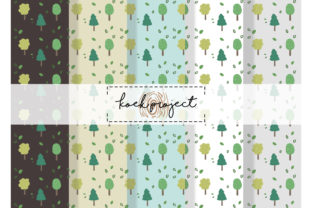
Tree Pattern Pack: Hand-Drawn Authenticity for Modern Creative Workflows
Designers, marketers, educators, and small business owners increasingly face a quiet but powerful tension: the need for speed and scalability versus the growing audience expectation for warmth, personality, and tactile authenticity. In this landscape, the Tree Pattern Pack stands out—not as a novelty, but as a practical response to a real shift in how visual language is perceived and trusted.
What Makes This More Than Just Another Pattern Collection?
This isn’t a generative AI output or a mass-produced vector tile. The Tree Pattern Pack consists of six hand-drawn digital files—five high-resolution JPGs and one transparent-background PNG—each capturing organic line weight, subtle texture, and intentional imperfection. These aren’t “trees” as botanical illustrations; they’re rhythmic, repeatable motifs rooted in gesture and observation. That distinction matters: it means the patterns feel grounded, not generic.
Because every element is drawn by hand, the pack avoids the clinical uniformity that can unintentionally flatten brand voice. A handmade tree motif on a workshop flyer, a course workbook cover, or packaging for an eco-conscious product doesn’t just “look nice”—it signals intentionality. It tells viewers: *This was made with care, not just assembled.*
Why Hand-Drawn Patterns Are Gaining Real Traction
Look closely at what’s happening across platforms: Instagram feeds favor layered, textured visuals over flat minimalism; print-on-demand creators report stronger engagement with designs that include sketch-like elements; even corporate training materials now incorporate illustrated patterns to improve information retention and emotional resonance.
This reflects broader behavioral shifts. Audiences—especially those aged 28–45—are more visually literate and skeptical of overly polished aesthetics. They associate smooth, algorithmically perfect graphics with automation, distance, or commercial detachment. In contrast, hand-drawn textures signal human involvement, craft, and relatability—qualities that build trust faster than stock imagery ever could.
The Tree Pattern Pack fits neatly into this movement—not as a trend-chasing gimmick, but as a tool built for today’s hybrid workflows. You can drop the PNG into a Canva presentation without losing edge detail. You can scale a JPG to full bleed for a poster and retain natural grain. You can layer it behind typography in Adobe InDesign and let the organic lines soften harsh contrast. It bridges analog sensibility and digital utility.
Practical Use Cases Across Roles and Projects
How professionals actually use pattern packs like this reveals their quiet versatility:
- Freelance designers use the PNG file as a non-destructive overlay in client presentations—adding subtle depth to mood boards without committing to final layout decisions.
- Educators and course creators apply the JPGs as background textures in printable worksheets or slide decks, reducing visual fatigue while reinforcing thematic cohesion (e.g., sustainability, growth, learning journeys).
- Small business owners print the patterns on kraft paper tags or fabric labels—leveraging the hand-drawn quality to reinforce artisanal positioning without needing custom illustration budgets.
- Bloggers and content marketers embed scaled-down versions as section dividers or newsletter headers, creating visual rhythm across long-form posts without relying on external image hosts.
- Hobbyists and makers combine the files with free tools like GIMP or Photopea to create custom wrapping paper, journal covers, or embroidery guides—extending the pack far beyond its original format.
Note the emphasis on interoperability: no proprietary software required, no licensing restrictions for commercial use, and no hidden dependencies. That’s by design—not because it’s “basic,” but because accessibility enables adoption. A pattern only works if it lives where people already work.
How File Formats Shape Real-World Flexibility
The download includes five JPG files and one PNG. At first glance, that may seem modest—but each format serves a distinct purpose in daily creative practice:
- JPGs offer broad compatibility and smaller file sizes—ideal for web banners, email headers, or quick mockups where transparency isn’t needed.
- The PNG preserves crisp edges and full alpha transparency, making it indispensable for layering over photos, applying as watermarks, or integrating into UI components where background context must remain visible.
This combination reflects how modern creators operate: rarely in one environment, but across multiple platforms and constraints. You might start in Figma using the PNG, export a JPG for social media previews, then repurpose a cropped detail as a sticker in a Notion workspace. The formats support that fluidity—not as afterthoughts, but as deliberate choices aligned with actual usage patterns.
Authenticity Without the Overhead
Many creators want “authentic” visuals but hesitate due to time, cost, or skill barriers. Commissioning custom botanical illustration can take weeks and hundreds of dollars. Learning vector tools well enough to mimic organic flow takes sustained practice. The Tree Pattern Pack sidesteps those bottlenecks—not by replacing skill, but by offering a starting point grounded in real craftsmanship.
Think of it like sourcing ethically harvested paper: you’re not doing the forestry work yourself, but you’re choosing a material with traceable integrity. Similarly, these patterns carry the evidence of handwork—varied line thickness, slight asymmetry, ink-like density shifts—so you benefit from that authenticity without replicating the labor.
That’s especially valuable for solopreneurs managing brand consistency across ten different touchpoints. One cohesive visual thread—like a recurring tree motif—builds recognition faster than constantly shifting styles. And because the patterns are subtle rather than dominant, they support content instead of competing with it.
Looking Ahead: Where Pattern Design Is Headed
Pattern libraries are evolving from static collections into modular systems. We’re seeing more demand for variants—light/dark versions, seasonal adaptations, scalable base elements—that allow users to remix rather than replace. The Tree Pattern Pack, while compact, anticipates this direction through its intentional variety: the five JPGs aren’t duplicates with minor tweaks. Each offers a distinct rhythm—one denser, one more open, one emphasizing vertical growth, another suggesting canopy spread. That variation invites thoughtful selection, not random application.
It also aligns with sustainable design practices. Reusing a single, well-made pattern across multiple outputs reduces the need for constant new asset creation—cutting down on redundant files, storage bloat, and decision fatigue. In an era where digital clutter is a recognized cognitive load, simplicity with substance has real value.
A Thoughtful Tool, Not a Magic Fix
No pattern pack solves branding strategy, messaging clarity, or audience insight. What the Tree Pattern Pack does offer is reliability: consistent quality, clear usage rights, and a visual tone that resonates across contexts. It saves time not by automating creativity, but by removing friction from execution—so you can focus energy where it matters most: connecting with your audience, refining your message, or launching that next project.
If you’ve hesitated to introduce organic texture into your work because it felt too niche, too time-consuming, or too hard to integrate—this is a low-risk, high-resonance entry point. It doesn’t ask you to change your process. It simply gives you one more honest, usable element to work with—drawn by hand, delivered digitally, ready when you are.